About the project
The Futurewheat project aims to develop a basis for better and faster assessment and clustering of domestic wheat quality in the future. To this end, investigations will be performed in a transdisciplinary approach. Alternative baking and dough tests will be established and compared with standard methods.
Future cultivation with reduced agrochemicals will have an impact on agronomic properties, but the consequences for baking quality and nutritional quality are unclear and will be investigated in this project. Data from registration trials will be used to supplement statistical evaluations with environmental and weather data and to recalculate environmental stability and nutrient use efficiency.
However, implementation along the value chain requires rapid methods of variety identification and baking and ingredient determination, which are comprehensively investigated using multiple sensors and machine learning and applied to the project's diverse data sets.
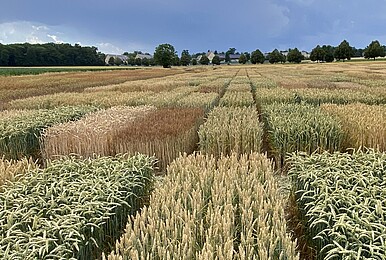
In TV1, extensive field trials will be conducted at multiple locations on 20 wheat varieties using different nitrogen fertilisation and fungicide application rates. The harvest samples will be comprehensively examined for a wide range of dough and baking qualities as well as ingredients. At the same time, a fermentation stability test will be developed and an alternative baking test examined and applied to the above samples. Based on comprehensive data sets from the registration trials, environmental stability and other trait indices for nutrient use efficiency will be developed.
The project is divided into four closely linked work packages:
WP1
WP1 uses multi-year field trials with 20 varieties at several locations to investigate how different nitrogen fertilisation and plant protection intensities influence yield, disease susceptibility, baking quality and nutrient content. Agronomic characteristics, baking and dough properties, as well as nutrients are recorded and linked using NIRS methods. The aim is to quantify the role of variety, environment and management in quality and to derive key breeding objectives for future cropping systems.
WP2
WP2 expands the description of baking quality by developing a high-throughput fermentation stability test and standardised mini baking trials. Protein and starch properties, fermentation stability, baking volume and crumb texture are systematically determined on extensive flour samples (including from WP1) in order to define practice-relevant quality parameters.
WP3
WP3 develops rapid tests for variety identification and assessment of processing properties using spectroscopy, image analysis and AI. Various sensor platforms are linked to reference data on protein content, dough and baking quality. At the same time, the Rapid Mix Test is being specifically adapted to protein-efficient varieties.
WP4
WP4 models genotype-environment interactions based on extensive registration trials, practical and weather data. The aim is to describe the environmental stability of yield and baking quality, develop new quality and efficiency indices, and establish stability parameters for the German wheat supply chain.
Overall, FUTUREWHEAT enables faster, protein-efficient and environmentally adapted assessment of domestic wheat qualities and supports breeding, cultivation, trade and processing through scientifically based quality clusters and rapid procedures.